
Reviewed · HISTORICAL TOURS
2-Hour Historical Walking Tour from Dublin
Dublin history can feel like a jigsaw puzzle, and this tour is a fast way to connect the pieces. I love the history postgraduates leading the walk and turning name-dropping into clear stories, and I love that you start at Trinity so the day has an obvious anchor. One thing to consider is that the history is political and detailed, so it is not a light, casual stroll.
The pace is built for people who want context without losing the whole day. You get around two hours of walking and explanation, then the rest of your day is free to explore on your own. I also like that the route ends at Christ Church Cathedral, so you can keep wandering without needing to backtrack.
Guides range from funny and animated to more serious and lecture-like, but the common thread is clarity and energy. I’ve seen names like Eoin and Jodie called out for keeping it engaging, with Caolan Maher and Daragh also praised for making the material easy to follow. Dress for the weather. Even on crisp days, the story flow keeps moving.
Key things to know before you go
- Start across from Trinity College Dublin at the Henry Grattan Monument on College Green, then step into the story right away
- History postgrad guides are the whole point here, so expect dates, causes, and consequences, not just photos
- A tight 2-hour route with eight major sites, designed to give you a strong overview fast
- Book of Kells context included, entry not included, so plan how you want to see it if you care about manuscripts
- Group size stays small (max 25), which helps with questions and hearing the guide
- You end at Christ Church Cathedral, a convenient launchpad for further exploring afterward
Why This 2-Hour Dublin Historical Walk Hits the Right Note
This works because it gives you a Dublin you can actually use. Instead of collecting facts at random, you learn how one era sets up the next one, from medieval power to British administration to 20th-century conflict. The guide gives you a timeline you can remember when you later see the same buildings on your own.
I also like the stop structure. Each location is close enough that the story stays together, but different enough that you are constantly changing your focus. You are not just hearing about rulers. You also get a sense of institutions, religion, law, and how people lived in between.
One more reason I like this format: it helps you plan. After a tour like this, you know what to revisit and what you can skip. If you want a Dublin that makes sense, this is a strong first-day move.
More walking tours in Dublin:
- Dublin Highlights and Hidden Gems Guided Walking Tour
★ 5.0 · 6,020 reviews - Dublin: Highlights and Hidden Gems Walking Tour
★ 4.9 · 2,140 reviews - 1916 Rebellion Walking Tour
★ 5.0 · 1,605 reviews
Meeting at Henry Grattan Monument, and What the Walk Feels Like
The tour starts at the Henry Grattan Monument on College Green, opposite the front gate of Trinity College Dublin. That exact starting point matters. If you show up at the gate itself, you can miss your guide, so aim for the monument and line up on the College Green side.
The group max is 25, and that size usually makes it easier to hear the guide even if the sidewalks are busy. You will be walking for about two hours in total, with short time at each stop. The terrain is simple enough, but it still adds up, so wear comfortable shoes and expect to stand outdoors during explanations.
Moderate physical fitness is the guide’s note, meaning it is not a marathon, but it is also not a sit-down museum tour. If you know you get tired easily with long standing or cold weather, plan accordingly and dress in layers.
Also, the tour uses a mobile ticket. If you like to travel light, this is a practical bonus.
Trinity College Dublin: Oldest University Energy and the Book of Kells Context
Trinity College Dublin sets the tone fast. You learn that it is Ireland’s oldest university, founded in 1592, and the guide uses the campus to explain why education mattered to power, culture, and identity. Even if you have passed Trinity before, you get a reason to look at the place instead of just taking a quick photo.
The star topic here is the Book of Kells, an 8th-century manuscript written in Latin, famous for the four Gospel texts. You get the historical background, what makes it significant, and why it became such a symbol of Irish cultural heritage.
Important detail for your planning: entry to see the Book of Kells is not included. So you have two options. If you mainly want the story, the tour is still worth it. If you want the artifact itself, you’ll need to arrange your own visit time on top of the walk.
Bank of Ireland and Temple Bar: How Dublin’s Power Shifted in Plain Sight
Next you move to the Bank of Ireland building, originally tied to colonial-era governance. The guide frames it as the site of Ireland’s colonial parliament, built in 1729, and later abolished by the Act of Union in 1800. That context matters. It is not just an attractive facade. It is a physical reminder of an era when political power was structured in a specific way, often linked to the Protestant Ascendancy.
Architecture gets a real-world explanation here too. The guide points out the neo-classical feel and connects style to authority. It is the kind of detail you might miss if you are just walking by for coffee.
Then you swing toward Temple Bar. The guide gives you the surprisingly human story of how this area was once earmarked for demolition, only to be repurposed in the 1990s as Dublin’s cultural quarter. This is one of the best moments for understanding how cities reinvent themselves. You see how a place that could have vanished became a branding and arts zone instead.
If you like strolling streets more than museums, Temple Bar is the part that lets you breathe and orient. Just keep in mind it is a popular area, so the vibe will depend on the time of day.
More history tours in Dublin:
- Dublin Historical Centre Food Tour with 8 Food Tastings & Drinks
★ 5.0 · 1,718 reviews - Historical 2-Hour Guided Walking Tour of Dublin
★ 4.7 · 865 reviews - Dublin to Cork, Blarney Castle & Cóbh Heritage Centre by train
★ 4.5 · 510 reviews - Dublin: Jeanie Johnston Tall Ship Irish Famine History Tour
★ 4.8 · 431 reviews
Wood Quay Amphitheatre: Viking Dublin Under Your Feet
Wood Quay is where the tour gains a time-travel feeling. You hear about archaeological excavations in the 1980s that uncovered parts of the Viking city, founded around AD 840. It is a quick stop, but the takeaway is big: Dublin did not start as a tidy medieval capital. It has layers, and some of the earliest layers are literally buried and waiting.
I like this stop because it breaks the usual story pattern. Many city tours focus mostly on one era. Here, you get pushed back into the earlier timeline, which makes later Irish history feel more connected instead of random.
You also learn to see the city differently after this. Even if you do not hunt for artifacts yourself, you start noticing that Dublin’s modern streets sit on top of older decisions, older settlements, and older trade routes.
Four Courts to Christ Church Cathedral: Law, Civil War, and English Invasion Footprints
At Four Courts, the guide ties architecture to conflict. This is Ireland’s legal headquarters, and the story includes how a civil war began in June 1922 between groups who supported and opposed the Treaty of December 1921. It is heavy material, but hearing it in the setting where law is supposed to be stable makes it hit harder.
If you get uneasy with politics, Four Courts is the stop to mentally brace for. It is one of the most direct political moments on the walk. Still, this is also why the tour earns its place for people who want Dublin history to make sense.
Then you shift to Christ Church Cathedral, Dublin’s oldest cathedral, founded in 1030 and rebuilt in stone in the 1170s by Strongbow, who was central to the English invasion of the 1170s. The guide uses the building’s age to explain how religious power and political power were tied together, not treated as separate tracks.
This is a good pairing with Four Courts. Together, they show how institutions can be both symbolic and practical, shaping what happens to real people when disputes turn serious.
City Hall and Dublin Castle: Catholic Emancipation and Why Dublin Got Its Name
City Hall is a great change of pace. Instead of focusing only on wars and institutions, you get a political campaign story anchored by Daniel O’Connell. The guide points to a statue of O’Connell inside, describing him as Dublin’s first Catholic Lord Mayor in 1840 and a key leader in the campaign for Catholic Emancipation in 1829, which aimed to end anti-Catholic laws. You also hear why he is known as The Liberator.
This stop helps you understand religion as politics, not background noise. In Dublin, it shows up in laws, leadership, and public identity. If you want to understand Ireland beyond slogans, this is one of the better places to start.
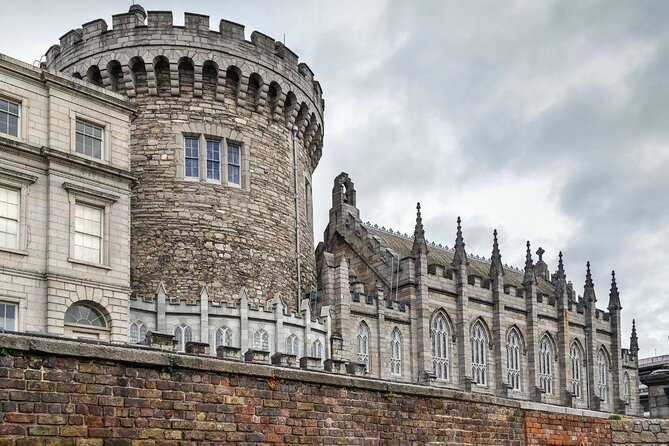
Finally, the tour ends at Dublin Castle. The guide covers how it was originally built by King John in 1204 and served as the seat of British administration until 1922. Again, it is not just a pretty historic complex. It is a message in stone about who ran things and how long the system lasted.
The tour also brings up Dubh Linn, the Black Pool, and connects it to Dublin’s name. That gives you a satisfying linguistic thread. You end with a quick origin story you can carry into the rest of your day as you explore.
Guides, Group Size, and the Big Value Question
At $22.98 per person, this is priced like a group tour, not a private guide. The best part is that you are buying a focused “why this matters” explanation rather than time spent figuring things out on your own. For many visitors, that is the difference between seeing Dublin as separate landmarks and seeing it as one long story.
The other value angle is the guide quality. The tour emphasizes that the guides are history postgraduates, and the effect is noticeable. People repeatedly praise guides for being easy to listen to, funny when appropriate, and able to keep the story moving even when the weather is uncooperative.
Group size also matters for value. With a max of 25, it is usually easier to hear questions and to stay on track. You are not battling a huge crowd, and you get more of a guided conversation feel than a broadcast.
One small consideration: because the tour is story-heavy, it can run dense if you prefer culture-focused wandering over politics. There is at least one sort of mismatch to watch for. If you want more “where to eat and what street this is” and less “who agreed to what treaty,” this may feel like too much.
Best Uses for This Tour on Your Trip
If you are in Dublin for a short time, take this early. It gives you context quickly, so later you understand what you are looking at. More than once, people highlight that it helps them orient themselves and decide what to revisit.
It also works well if you like history but you want it connected. You get Viking-era clues, medieval power, cathedral building history, and 20th-century turning points, all in one route.
And it is a smart way to avoid the common problem of reading about Ireland in pieces online. This tour puts the pieces in an order you can keep.
If you are traveling with someone who finds political history hard, you can still benefit. Just tell them what to expect up front: this is not trivia. It is cause and effect.
Should You Book This Historical Walking Tour of Dublin?
Book it if you want a guided, stop-by-stop map of how Dublin turned into what you see today. You will like it most if you enjoy clear storytelling, institutions, and the bigger reasons behind the landmarks.
Skip it or consider another style if you want a lighter cultural stroll with minimal politics. This route is intentionally historical, and the guide does not treat politics as an optional chapter.
My practical advice: wear layers, bring comfortable shoes, and plan time for a Book of Kells visit if that is on your personal must-see list. If you do those things, you will finish the tour with a Dublin that feels legible, not just pretty.
FAQ
How long is the Dublin walking tour?
It runs for around two hours.
Where do I meet the guide for this tour?
You meet at the Henry Grattan Monument on College Green, opposite the front gate of Trinity College Dublin.
What language is the tour offered in?
The tour is offered in English.
Is entry to the Book of Kells included?
Entry to the Book of Kells is not included.
How large are the groups?
The tour has a maximum of 25 travelers.
What kind of walking difficulty should I expect?
The tour calls for moderate physical fitness, and you should be prepared for a steady walking pace over the two hours.
Is free cancellation available?
Yes. You can cancel for a full refund if you cancel at least 24 hours in advance of the experience start time.
Fresh options around Dublin
- Wicklow: Private Day Tour from Dublin★ 5.0 · 5 reviews
- Wicklow Mountains Private Day Tour including Glendalough★ 5.0 · 7 reviews
- Women Of Ireland: Trailblazers & Pioneers★ 5.0 · 4 reviews
- Wicklow Mountains & Glendalough Luxury Private Day Tour★ 5.0 · 23 reviews
- Wicklow tour of Glendalough★ 4.5 · 8 reviews
- Dublin To Kilkenny Castle Waterford Crystal Private Car – Day Tour★ 5.0 · 8 reviews
- Waterford Crystal and Kilkenny Full-Day Rail Tour from Dublin★ 5.0 · 3 reviews
- Full Day Private Wicklow Tour★ 5.0 · 12 reviews
Historical Tours, compared.

Dublin Historical Centre Food Tour with 8 Food Tastings & Drinks
Read our review →
Historical 2-Hour Guided Walking Tour of Dublin
Read our review →
Dublin to Cork, Blarney Castle & Cóbh Heritage Centre by train
Read our review →
Jeanie Johnston Tall Ship Irish Famine History Tour
Read our review →

Deliciously Dublin: The Artisan Donut Walking & History Tour
Read our review →
Hidden Dublin: Haunted History Walking Tour v2.0 2026
Read our review →
Dublin Private Highlights & History of 1916 Easter Rising Tour
Read our review →Browse the lists this tour appears in