
Reviewed · WALKING TOURS
Dublin: Hidden Gem Walking Tour with Local Guide
Tallaght has a reputation for being overlooked, but that is exactly why this walk is so interesting: you spend two hours tracing how a suburb became a crossroads of writing, war reporting, mythology, and everyday Irish life. I love the way the route connects people you recognize with places you would not expect to matter. I also like that it stays small, conversational, and story-driven, guided by Sophie, who brings the details in without turning it into a lecture.
The main drawback is also the most basic one: it is outdoors and it relies on good weather, so if the forecast looks nasty, build in a little flexibility. Also, if you want only classic Dublin monuments, this will feel intentionally different, focused on Tallaght’s many layers instead.
Key highlights you will not want to miss
- Katharine Tynan at Whitehall: her links to W.B. Yeats and George William Russell (AE), plus letter excerpts
- William Howard Russell, born in Jobstown: one of the first war correspondents, with stories spanning major conflicts
- Oisín in the Land of Youth: Irish mythology with a bilingual Irish and English version and a mountain viewpoint
- Tallaght Aerodrome and wartime change: how the area shifted from WW1 through later conflict periods
- Urney Chocolates in Tallaght: the Gallagher family story and how local brands shaped the town
- An ending that teaches Irish basics: a few phrases, then an optional stop at a bilingual café
Tallaght in 2 hours: why this walk feels like a fast education
This tour is all about getting your bearings in an area people usually treat as a pass-through. Instead of asking you to admire one landmark, it asks you to notice patterns. Tallaght’s story shows up in writers and journalists, in old religious sites, and even in how major brands took root and then moved on.
The “two hours” part matters. You do not get stuck in one stop for long, yet you still get enough context to understand why each place matters. The size also helps: with a maximum group size of 12 travelers, you get more back-and-forth and more time to ask questions as the guide goes.
Value is good here too. At $18.05 per person, you get a local guide, a mobile ticket, and a route where each listed stop is ticket-free. That makes it one of those rare experiences where the ticket price mostly pays for your guide and time, not entry fees.
More walking tours in Dublin:
- Dublin Highlights and Hidden Gems Guided Walking Tour
★ 5.0 · 6,020 reviews - Dublin: Highlights and Hidden Gems Walking Tour
★ 4.9 · 2,140 reviews - 1916 Rebellion Walking Tour
★ 5.0 · 1,605 reviews
Before you go: pace, meeting point, and what to expect on your feet
The walk runs about 2 hours and is offered in English. It is designed so most people can participate, and it is close to public transportation, so you are not committing to a full day of logistics.
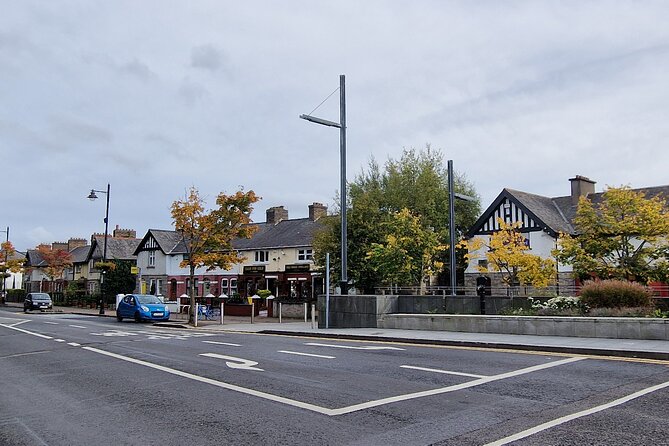
Your meeting point is Kingswood Kilnamanagh, Dublin (Co. Dublin). You end in Tallaght Village at R819, right by a bilingual Irish/English café. That matters because the last part of the tour naturally blends into real local life, not just a “thanks for coming” finish.
What I would plan around: the stops are in and around residential areas, retail areas, a campus, and a church site. Expect a steady walking rhythm, and bring a layer. Also, the tour requires good weather, so check the forecast the morning of your date.
Kingswood Heights to Whitehall: Tallaght begins with Katharine Tynan
The tour starts at Kingswood Heights/Kilnamanagh, where you get a quick orientation to Tallaght’s beginnings in ancient Irish history. It sets the tone: even when the surroundings look modern, the guide keeps pointing out that the ground has stories.
Then you move to a key literary stopping point: the former residence connected to Katharine Tynan, at Whitehall. This is where the tour really starts to feel special if you like Irish writing. You learn about her life inside Irish and English literary circles, her own writing, and how she was described by AE as an early voice in the Irish Renaissance.
The best part here is not just the name recognition. The guide shares contents of letters connected to Katharine’s friendships with W.B. Yeats and George William Russell (AE), and you get a sense of how these relationships formed in real places, not just in textbooks.
Practical note: this stop is on the shorter side, around 15 minutes, so you will not drown in dates. You will, however, leave with the feeling that Tallaght was not “out of the way.” It was plugged into the same creative world you associate with Dublin.
Belgard Road: William Howard Russell and the reality of war correspondence
Next you head to Belgard Road and the life of William Howard Russell, born in Jobstown, Tallaght. If you have ever wondered how people first understood distant wars, this stop is a strong answer. He is considered one of the first war correspondents, and his reporting became closely associated with major conflicts.
What you get is a timeline that stretches far beyond one event. The guide connects his early life in Tallaght to a long reporting career that includes major Irish moments like the meetings around Daniel O’Connell and coverage during the Great Famine. It also covers wars farther afield, including the Crimean War and the American Civil War.
There’s also a charming human link: you briefly explore his friendship with Charles Dickens, and the guide shares writings and letters connected to Russell. This is a good example of why the tour is worth the modest price. You are not just hearing “he was famous.” You are seeing the personal texture behind that fame.
Drawback to consider: if your interest is strictly local and you dislike global connections, this stop will still move you into international stories. I think it works anyway, because it shows how Tallaght produced a journalist who looked outward. That outside focus makes the Tallaght origin feel even more grounded.
A few more Dublin days worth comparing
- Dublin to Glendalough, Wicklow and Kilkenny Full Day Guided Tour
★ 5.0 · 4,895 reviews - Dublin Book of Kells, Castle and Molly Malone Statue Guided Tour
★ 4.5 · 3,825 reviews - The Little Museum of Dublin Famous Guided Tour
★ 5.0 · 2,948 reviews - Dublin Jameson Distillery and Guinness Storehouse Guided Tour
★ 4.5 · 2,608 reviews
Oisín mythology and Dublin Mountains views from the Belgard Road stop
Another Belgard Road stop shifts from journalism to legend. The guide first gives background on Irish mythology, then focuses on one of the best-known stories: Oisín I dTír na nÓg, also known as Oisín in the Land of Youth.
You get a bilingual version of the legend, in Irish and English, which is a fun change of pace. Even if your Irish is rusty, the bilingual approach helps you follow the meaning rather than just listen for atmosphere.
And there is a location payoff: this stop includes a lovely view of the Dublin Mountains. So you get story plus scenery, without it turning into a long detour.
If you hate standing still or taking in views when it is rainy, that is the one thing to plan for. The stop is about 10 minutes, so it is manageable, but it is still outdoors.
Belgard Retail Park: Tallaght Aerodrome, Urney Chocolates, and everyday economic change
At Belgard Retail Park, the tour zooms into a side of Tallaght that feels surprisingly layered. You look at the history of the former Tallaght Aerodrome and its role from WW1 through the Irish War of Independence and the Irish Civil War period. It is one of those places where you can stand in a modern commercial area and still sense that earlier decades left real marks.
Then you shift into a distinctly local theme: the Gallagher family and how they brought Urney Chocolates into being. You learn how Urney Chocolates became tied to Tallaght for decades until it closed in 1980, and you also hear how the brand lives on.
The guide also touches on another well-known brand that operated in Tallaght for a time, Jacob’s, and you talk about how these kinds of businesses shaped the area. This is more than nostalgia. It is a quick way to understand how jobs and companies affect neighborhoods, then vanish, then leave traces.
Time-wise, this stop is around 15 minutes, so you will get a solid chunk of narrative without being stuck in one location too long.
TU Dublin, Tallaght Campus: how fast growth can change a place
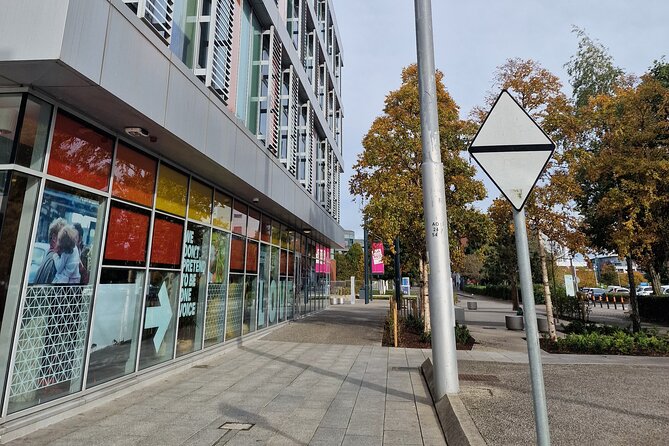
The next stop is at TU Dublin, Tallaght Campus, and it is the tour’s reality check about urban change. You examine the transformation of Tallaght from the 1970s to the 1980s, when it became one of the largest urban areas in Ireland.
You also get numbers and framing that help you understand why it felt so sudden: Tallaght in the 1980s was one of the fastest growing urban centres in Western Europe. The guide connects that growth to Ireland’s wider economic difficulties at the time, including high unemployment and high emigration.
This stop matters because it helps you interpret everything else on the walk. The literary connections, the military era sites, and the brand stories all become easier to understand when you see how fast the town expanded and how that expansion affected the people living there.
This is still a walking tour, so the emphasis stays on what you can see and what you can connect. But it is also the most reflective stop on the route.
St Maelruain’s: from ancient monastery roots to Alice Furlong’s Irish language advocacy
At St Maelruain’s Church of Ireland, the tour moves into older spiritual ground. You learn that the church stands on what used to be a monastery that mattered in ancient Ireland. The guide connects St Maelruain’s with Finglas and describes them as known as the two eyes of Ireland.
You also get a quick look at St Maelruain himself and how the present day church came into being. The short time slot, around 5 minutes, means you will not get a deep architectural lesson, but you will leave with the big idea that this spot was central long before Tallaght became a modern town.
Then you return to St Maelruain’s Church for another stop, around 15 minutes, focused on Alice Furlong, who is buried on the grounds. This is one of the best “why Tallaght matters” moments on the tour because it is not just local pride, it is national cultural effort.
You learn that Alice Furlong was a founding member and vice-president in Inghinidhe na hÉireann, the Daughters of Ireland. You also hear how she wrote and how she advocated for the Irish language, with poetry offered in Irish and professional translations into English provided.
What I like about this part is the practical angle. You leave with a sense that language revival is not abstract. It is something people in Tallaght actively carried, including through poetry.
Tallaght Village Green: Fenian Rising, Dickens links, and Thomas Joseph Byrne cottages
The tour heads to Tallaght Village Green, where you see a plaque commemorating the Fenian Rising of 1867 and learn about Tallaght’s role in it. The guide also shares writings from Charles Dickens connected to this period in Tallaght.
So you see the Dickens connection again, echoing the earlier Russell stop. That “threading” effect is one reason the tour feels cohesive. It is not random topics. The guide keeps showing how one figure can connect to several places and several eras.
Then you end at Tallaght Village, and the final stretch includes details that feel very “you are here now.” You look at cottages designed by architect Thomas Joseph Byrne, one of the most influential architects of the day. There is also a quick chat about the Dublin and Blessington Steam Tramway, which ran through the area before closing in 1932.
This ending hits a sweet spot. You get a tangible link to architecture and transport history, then you close with language.
The Irish lesson and the bilingual café finish
At the end, you are taught some basic Irish, and you briefly chat about the Irish language. The guide encourages you to use a bit of what you learned at a special local café right in the heart of Tallaght Village.
This is a small add-on, but it makes the tour feel less like homework. It turns learning into a chance to try a couple words in a real setting. If you like experiences that teach you something you can use immediately, this ending is a strong reason to book.
Is it worth $18.05, and who should book this walk?
I think the price makes sense because you are paying for time, a local guide, and a route where most stops are ticket-free. You also get a tightly packed narrative across literature, journalism, mythology, and modern growth. For $18.05, you are not buying “one attraction.” You are buying context.
This tour is a great fit if:
- you want a Dublin experience that does not stay glued to the city centre
- you enjoy stories tied to named people like Katharine Tynan, W.B. Yeats, AE, William Howard Russell, Charles Dickens, Alice Furlong, and Thomas Joseph Byrne
- you like small groups and conversational guiding, where questions feel normal
- you are curious about how Ireland’s language and identity show up in everyday places
It may be less ideal if:
- you want only famous buildings and major tourist sites
- you dislike walking in weather that changes quickly
- you prefer purely local details without moving into international war reporting
Should you book it?
Yes, if you like the idea of seeing how Tallaght grew from deep roots into a modern Dublin district with major cultural output. This walk is exactly the kind of short, focused tour that helps you understand an area fast, without skipping the human details.
If you are visiting Dublin and want one experience that feels local and thoughtful, book it. If you only have room for one “history thing,” pick this one, because it links myth, literature, journalism, and real-world change into a route you can actually picture later.
FAQ
How long is the Dublin Tallaght walking tour?
It runs for about 2 hours.
What does the tour cost?
The price is $18.05 per person.
Where does the tour start and end?
It starts in Kingswood Kilnamanagh, Dublin, Co. Dublin, and ends in Tallaght Village at R819 beside a bilingual Irish/English café.
Is the tour in English?
Yes, it is offered in English.
What is included with the ticket?
You get a mobile ticket and a local guide, and the tour is run as a small group.
Is there an entry fee at the stops?
The tour information lists admissions as free for the stops on the route.
How large is the group?
The maximum group size is 12 travelers.
Is it suitable for most people?
The tour says most travelers can participate.
Do I need good weather?
Yes, the experience requires good weather. If it is canceled due to poor weather, you will be offered a different date or a full refund.
Are service animals allowed?
Yes, service animals are allowed.
Does the tour teach Irish or include language practice?
Yes. You are taught some basic Irish, and you can use some of it at the local café at the end of the tour.
Fresh options around Dublin
- Wicklow: Private Day Tour from Dublin★ 5.0 · 5 reviews
- Wicklow Mountains Private Day Tour including Glendalough★ 5.0 · 7 reviews
- Women Of Ireland: Trailblazers & Pioneers★ 5.0 · 4 reviews
- Wicklow tour of Glendalough★ 4.5 · 8 reviews
- Wicklow Mountains & Glendalough Luxury Private Day Tour★ 5.0 · 23 reviews
- Dublin To Kilkenny Castle Waterford Crystal Private Car – Day Tour★ 5.0 · 8 reviews
- Waterford Crystal and Kilkenny Full-Day Rail Tour from Dublin★ 5.0 · 3 reviews
- Full Day Private Wicklow Tour★ 5.0 · 12 reviews
Walking Tours, compared.
Dublin Highlights and Hidden Gems Guided Walking Tour
Read our review →
90 Minute Dublin Walking tour and Sightseeing tips
Read our review →
Historical 2-Hour Guided Walking Tour of Dublin
Read our review →
Dublin Traditional Irish 3 Course Meal Walking Tour with Local
Read our review →
Browse the lists this tour appears in